 Osmosis
 connects cross-chain assets to onchain trading and liquidity pools
Osmosis is a decentralized exchange on its own Cosmos SDK blockchain, where cross-chain assets trade through liquidity pools and onchain orderbook markets. Inter-Blockchain Communication (IBC) brings tokens between compatible chains, while the exchange routes swaps across available liquidity. A quote estimates the output; the transaction’s execution limits determine whether an acceptable trade can complete. Slippage protection can reject a swap even after a separate deposit succeeds. Beyond exchanging tokens, the chain supports liquidity provision, OSMO staking, governance, and applications built with smart contracts. Each activity has different requirements: trading needs accessible liquidity, transfers need working connections, and staking commits tokens to network security.
Bottom line: An exact-input swap completes only when its output meets the minimum you authorize, even after a separate IBC deposit succeeds.
A completed deposit opens the path to a swap
With a manual IBC deposit, funds arrive on the trading chain before a separate swap uses the balance. If the swap fails its minimum-output check, that failure doesn’t undo the completed deposit. A fresh quote lets you decide whether to retry the swap without repeating the transfer.
Start with a supported token on a compatible source chain, an intended recipient, and enough balance for applicable fees. The token’s denomination identifies the actual asset. Before signing the swap, review its input, output, and minimum received amount.
| Stage | Observable state | Protection or limit |
|---|---|---|
| Prepare the deposit | Available source balance and intended receiving account | The selected asset and transfer path must be supported. |
| Submit the IBC transfer | Source-chain transaction and outgoing packet | Source confirmation doesn’t establish destination receipt. |
| Confirm arrival | The expected token appears in the receiving balance. | Match the actual denomination, not just its display symbol. |
| Review, sign, and submit the swap | A route, estimated output, and minimum-output limit | The quote remains conditional on execution against available liquidity. |
| Check the executed trade | Successful onchain execution and the corresponding received amount | A broadcast response alone doesn’t prove the swap completed. |
Once the trade has executed successfully, compare the received token and amount with its transaction record. A confirmed minimum-output failure supports reviewing another quote. An unresolved submission calls for checking its status before authorizing another swap.
What do price impact and slippage measure?
Price impact measures how your trade moves market prices; slippage measures the difference between a quoted price and the eventual execution price.
Price impact from the trade
An automated market maker (AMM) prices trades using the pool’s rules and available liquidity. Exchanging tokens changes that liquidity and moves the price along the pool’s curve. A larger input relative to usable depth generally produces greater price impact. Concentrated pools require attention to liquidity across the prices the trade would traverse.
Increasing slippage tolerance doesn’t create liquidity or remove the price impact already present in a quote. It changes the acceptable execution boundary.
Slippage between quote and execution
Other transactions can change a pool after you receive a quote. For an exact-input swap, the input amount stays fixed and the transaction specifies a minimum output. Execution below that minimum fails. This protects the selected output boundary, while leaving other failure conditions, including insufficient fees or gas, intact.
A higher tolerance accepts a lower minimum received amount for the same quote. A smaller trade may reduce its own price impact; waiting may produce a different quote. Neither action promises a better market price. The proposed output still needs to meet your requirement.
IBC paths determine which token arrives
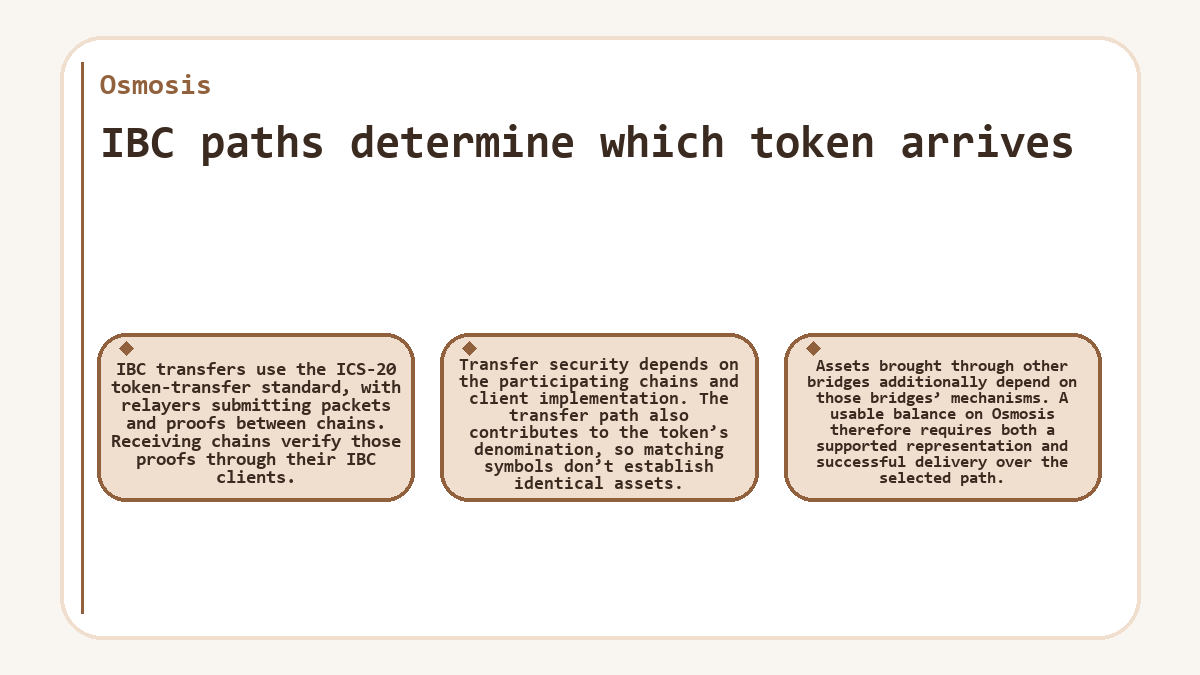
IBC transfers use the ICS-20 token-transfer standard, with relayers submitting packets and proofs between chains. Receiving chains verify those proofs through their IBC clients. Transfer security depends on the participating chains and client implementation. The transfer path also contributes to the token’s denomination, so matching symbols don’t establish identical assets. Assets brought through other bridges additionally depend on those bridges’ mechanisms. A usable balance on Osmosis therefore requires both a supported representation and successful delivery over the selected path.
Routing connects pools and limit orders
The exchange combines different market designs through its pool manager. Weighted pools, stableswap pools, concentrated liquidity pools, and supported CosmWasm markets contribute different liquidity. Routing can use intermediate assets or split an input across paths. The resulting quote reflects the selected route. Exact-input swaps fix the amount paid; supported exact-output swaps fix the amount received and cap the input.
Orderbook markets add resting limit orders alongside AMM liquidity. A buy order sets a maximum purchase price, while a sell order sets a minimum sale price. Filling requires matching trading activity; placing an order doesn’t establish a completed exchange. Ordinary swaps can also consume orderbook liquidity through routing. The choice between a swap and a limit order concerns execution timing and acceptable price.
How are trading fees different from gas fees?
Trading fees apply to the exchange of assets, while gas fees pay for transaction processing on the blockchain and require a separate balance budget.
Charges within the quoted output
The spread factor is a pool’s swap fee, and the protocol also charges taker fees. Those charges can differ across pools, token pairs, and trade directions. The routed quote accounts for applicable swap fees in its estimated output. Subtracting the same fees again would misstate the amount the quote offers. Price impact remains a separate explanation for execution away from a spot price.
Network costs and accepted fee tokens
Gas costs depend on the transaction’s computational requirements and the network’s dynamic base fee. A fee below the applicable minimum can prevent admission. OSMO is the native fee token, and an onchain allowlist permits other accepted assets. Trading support doesn’t automatically make a token eligible for gas payments. Cross-chain transfers can also incur fees on their source network or through their selected route.
Liquidity positions earn from trading activity
Liquidity providers supply assets traders exchange, receiving trading fees and, for eligible positions, additional incentives. Their exposure changes as trades alter the assets they hold.
Pool shares and selected ranges
Traditional weighted pools represent a provider’s share with liquidity-provider tokens. Concentrated positions allocate liquidity within chosen price bounds. Concentrated liquidity earns swap fees only while the market price lies within the position’s selected range. A narrow range can concentrate capital near a trading price, while increasing the chance the position moves out of range. The position’s asset composition can change substantially as prices move.
Fees, incentives, and changing balances
Impermanent loss describes a position falling behind the value of simply holding its deposited assets as relative prices change. Earned fees may offset that difference, but they don’t guarantee a profitable position. Additional rewards depend on the pool’s incentives and eligibility rules; some require bonding. Expected fee income therefore depends on trading activity and the liquidity competing for those trades.
What does staking OSMO change?
Staking OSMO contributes to the chain’s proof-of-stake security and supplies governance voting power, while moving the delegated balance out of immediately transferable funds.
Validators produce blocks, and delegators assign their stake to validators without granting them spending control. Rewards depend on protocol distributions and validator commission. Misbehavior or qualifying downtime can lead to slashing, which can reduce delegated stake. Unstaking starts an unbonding period during which the tokens aren’t transferable and don’t earn staking rewards. Governance uses staked voting power to decide proposals about upgrades, parameters, and community spending.
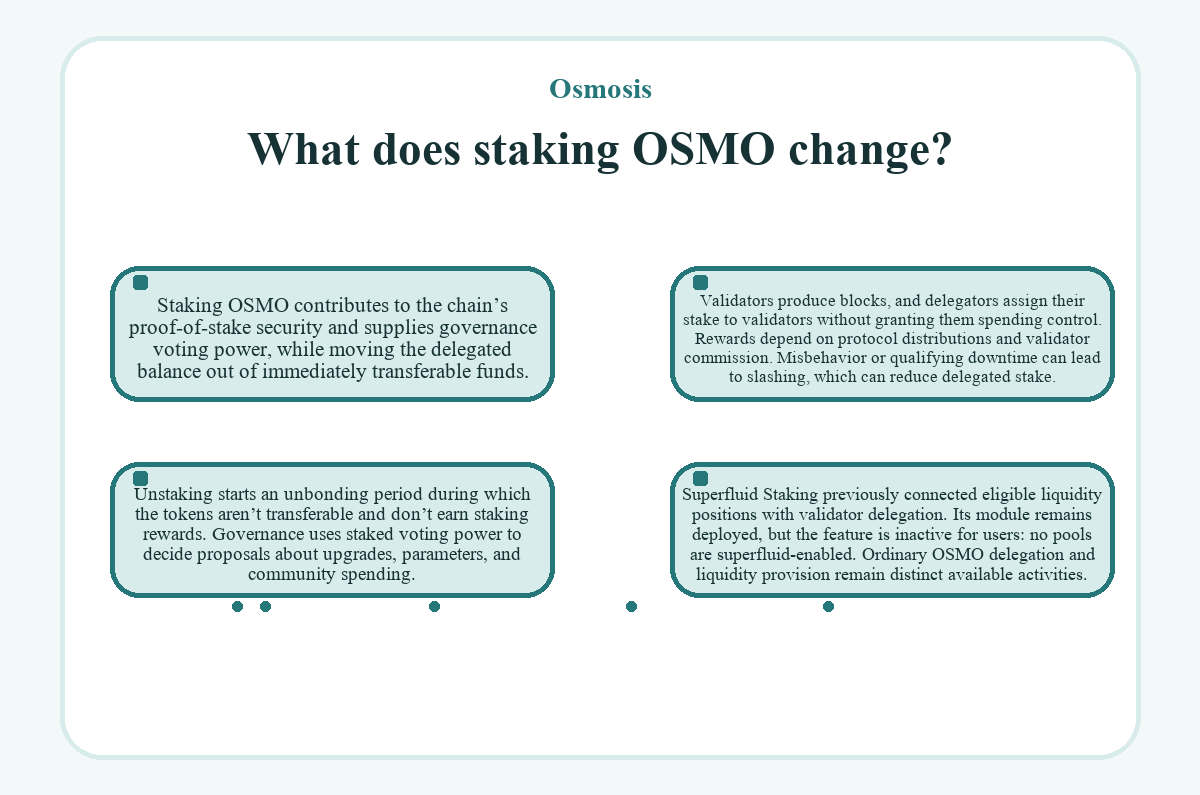
Superfluid Staking previously connected eligible liquidity positions with validator delegation. Its module remains deployed, but the feature is inactive for users: no pools are superfluid-enabled. Ordinary OSMO delegation and liquidity provision remain distinct available activities.
Applications extend the chain’s exchange functions
CosmWasm supports smart contracts, and the token factory enables permissionless creation of native assets. Token administrators can control minting, burning, and metadata. IBC hooks let an incoming transfer trigger a contract call, supporting integrated cross-chain swaps where the route implements them. Smart accounts supply configurable authentication for features such as limited trading sessions. Choosing between trading, providing liquidity, and delegation starts with whether you want exchanged assets, market-making exposure, or committed stake.
Worth knowing
-
Can I trade without staking OSMO?
- Trading doesn’t require staking OSMO. Delegation concerns network security and governance, while swaps use available balances and market liquidity. You still need enough transferable funds for the trade and an accepted fee token for the transaction; a staked balance isn’t available to spend immediately.
-
Does connecting a wallet expose my recovery phrase?
- Connecting a wallet to the exchange doesn’t require entering your recovery phrase into the trading website. The wallet handles connection approval and transaction signing. A recovery phrase gives control over the wallet, so a request to type it into a swap or support form is unsafe.
-
Are transaction amounts on Osmosis public?
- Onchain transaction records expose participating addresses and transferred token amounts. Self-custody concerns who controls funds; it doesn’t make the transaction history private. Anyone able to query the chain can examine those records, and repeated use of an address can reveal patterns of activity.
-
How long does an IBC deposit take?
- An IBC deposit completes when the receiving chain processes the transfer successfully. Timing depends on the selected path, chain operation, and relayer delivery. Approval on the source chain doesn’t establish arrival, and an estimated transfer time doesn’t promise when the destination balance will update.
-
Can a One Click Trading session be revoked before expiry?
- You can revoke an active One Click Trading session with a transaction signed by the account’s main wallet key. Successful execution removes the session’s authenticator, ending its authority, and the frontend discards its local session key. Revocation doesn’t reverse trades the session already executed.
-
Why can a token exist onchain without appearing in the app?
- Protocol-level token creation and frontend asset listing follow different processes. Creating a native token doesn’t automatically complete the asset-list pipeline or establish verified status in the interface. Frontend recognition involves asset registration and, for verified status or advanced configuration, additional review.
-
Is it possible to vote differently from my validator?
- A delegator can cast a governance vote that overrides the validator’s vote for that delegated voting power. If the delegator doesn’t vote, the validator’s choice applies. The override changes the vote on the proposal; it doesn’t move the delegation to a different validator.
-
What prevents cancellation of a limit order with an unclaimed partial fill?
- The orderbook contract rejects cancellation while an order has unclaimed fills. Only the original placer can cancel a completely unfilled order. Claiming executed proceeds is a different operation; a partial claim leaves the unfilled quantity on the orderbook and doesn’t itself cancel it.